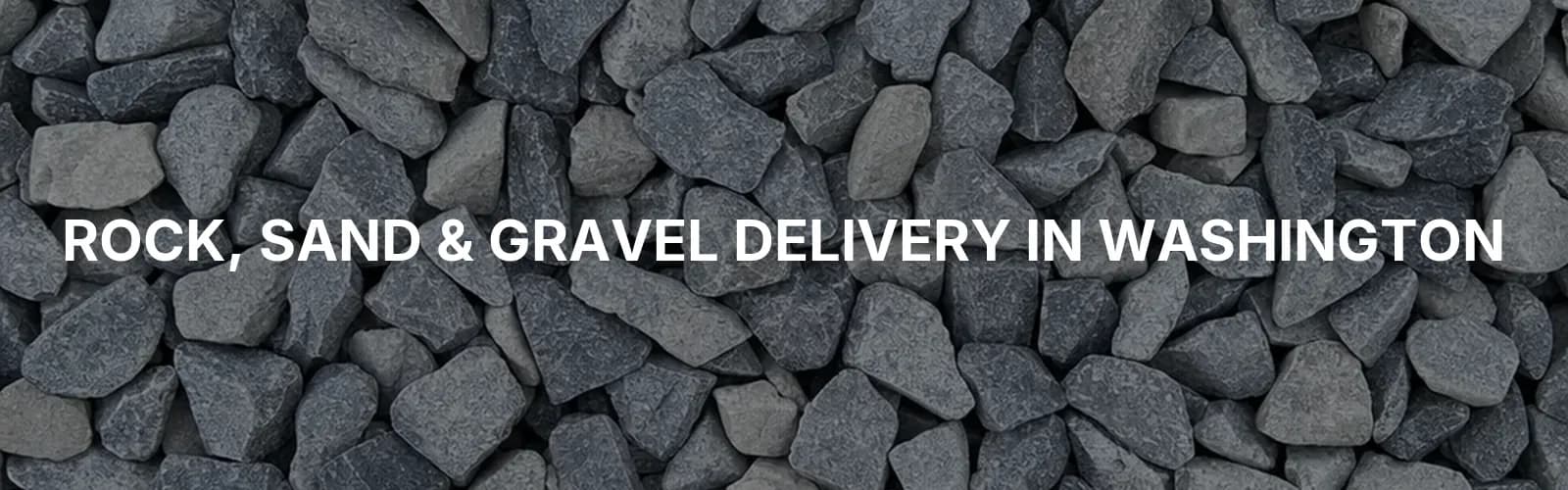
Order 5/8 Minus and Crushed Stone in Clallam County, WA
The reliable dry window in Clallam County, WA runs mid to late summer, and that short stretch decides when a load of gravel, stone and aggregate delivery in Clallam County, WA can go down and set. Washington Rock Supply delivers bulk material to the driveway, pad or bed you are building.
Order 5/8 minus for the top course. It is crushed rock with the fines left in, so it packs hard and sheds water instead of soaking it up, which matters on ground that stays wet most of the year.
Materials Delivered in Clallam County
The minus and clean split is the first thing to get right. Minus means the crusher fines stay in the rock so it compacts.
Clean means they are washed out so it drains. Both are sold here in the sizes Washington crews order by name.
5/8 minus carries the most weight for local work.
Contractors shorten that name to CSTC and order it as 5/8 minus.
Choosing the Right Material
Jefferson County sits in the same ground region as Clallam County. Thin, stony soil over uplifted marine rock on the Olympic slopes, deep organic forest soil in the west-side valleys, and sand, peat and tidal silt along the outer coast and the bays.
Glacial deposits reach the edges of the peninsula.
Because the ground is the same, the material choice is the same. Start a drive with 1 1/4 minus as the structural course, then top it with 5/8 minus.
Where the ground holds water, put drain rock under the base before anything else goes down.
For a paver walk or patio, bed the units in stone screenings and sweep the joints with mason sand. For a soft path that packs down, use walkway gravel.
Ground Conditions Across Clallam County
The driver here is volume. Across the Olympic Peninsula and the Pacific coast, the coast and the west-facing valleys take 100 to 170 inches of rain a year, so the question is never whether water arrives but where it goes.
Ground that is already saturated will not hold a base course without a drainage layer under it. On thin, stony soil over uplifted marine rock, water has little to soak into and moves sideways instead.
On the outer coast and the bays, sand, peat and tidal silt drain unevenly. A granular course placed directly on that ground can pump and lose its shape, so a washed layer belongs underneath it.
Erosion comes from sheer rainfall on steep, thin-soiled slopes, streambank scour in rivers that rise fast off the Olympics, and surf, drift and storm surge working the shoreline. Use riprap on cut slopes, banks and outfalls, and large river rock where a smaller stone would be carried off in a winter storm.
Timing matters as much as material. The two-day soil stabilization rule for western Washington applies from October 1 through April 30, and on the coast that is the practical limit on open grade.
Winters stay mild and hard freezes are short, so what stops work is how wet it is, not how cold. Footing depth is set by the county or city building department.
Delivery Across Clallam County
Order online by the ton or by the yard. Each product page has a calculator to size the load.
Pick a delivery date at checkout, and a dump truck tips the material in one pile on site.
Have the drop spot clear and reachable before the truck arrives. Bulk loads come off the back of the truck in a single pile, so leave room for the material and for the truck to get in and out.
Delivery covers Port Angeles, Sequim, Forks, Clallam Bay, Sekiu and Beaver, along with the rural drives and job sites between them.
Questions About Gravel and Stone in Clallam County
What is the difference between topsoil and fill dirt?
Fill dirt is common borrow, an unscreened material used to raise grade, backfill over-excavations and build up low spots before a granular course goes down. Gravel borrow in Section 9-03.14(1) is the granular structural fill, a different material.
Screened topsoil is blended for growing, so it belongs on the surface where plants root, not under a base.
What is 5/8 minus and what is it used for in Clallam County?
5/8 minus is crushed rock with the fines left in, so it compacts and sheds water rather than soaking it up.
Use it for driveways, parking pads and shed or shop slabs, placed over a structural base course.
How deep should a gravel driveway base be in Clallam County?
Depth depends on the ground under it, the load it will carry and how wet the site stays, so there is no single figure that fits every drive here. On saturated ground the base course needs a drainage layer beneath it before depth helps.
Each product page has a calculator to size the quantity once you settle on the build-up.
Order Gravel, Stone and Soil for Your Clallam County Project
Washington Rock Supply delivers 5/8 minus, 1 1/4 minus, drain rock, crushed stone, sand and soil for drives, parking pads, slabs, drainage, paths and planting beds across Clallam County. Choose the material for the job, size the load on the product page, and place your order online for delivery.